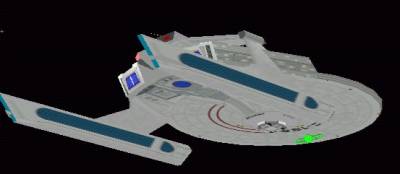
MIRANDA CLASS VESSEL
Sciences / Tactical / Exploration
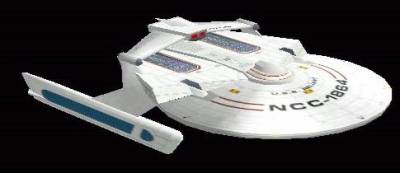
Although the shields of the Miranda class are nearly equal to those of a Constitution class, her hull is much less resilient. Unable to sustain many direct hits once the shields are down, the Miranda class is vulnerable in this respect. In such situations, the crew must rely on the ship's speed and maneuverability to survive.
The Miranda class project was developed to meet Starfleet's need for a medium-sized starship that would be easy to produce and offer adequate defensive and scientific capabilities with lower maintenance than the larger Constitution class ships. Due to its economical nature, designers planned to use existing starship components.
At the project's inception, Starfleet was updating most fleet designs and components. The project was delayed for a year to incorporate new technologies, but the basic saucer-with-dual-nacelles design was already complete. Once the new equipment became available, the project resumed, integrating components from the Constitution refit and Soyuz class. The first production model, U.S.S. Miranda NCC-1801, was delivered within seven years.
Many ships of this class were produced and became fleet workhorses, serving in defensive, scientific, and transport roles where larger starships would be inefficient. The class replaced the Oberth science class due to its lack of defensive capability. The Miranda class remains one of Starfleet's most flexible and successful designs.
Crew Compliment:
250
Primary Weapons Systems:
2 Forward and 2 Rear Phaser Banks
Secondary Weapons Systems:
2 Forward and 2 Rear Photon Torpedo Bays
Torpedo Compliment:
60
Deflector Shield Rating:
Medium
Mass:
Light
Maneuverability:
Good